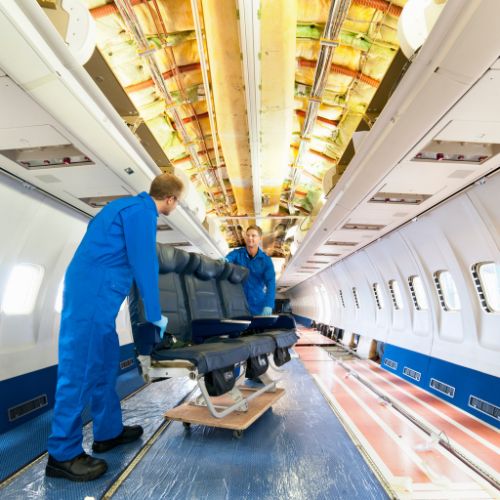
This 25-day foundation course prepares inexperienced, entry-level personnel to safely and effectively participate in aircraft dismantling, retirement and scrap preparation operations on aircraft. Designed around a step-by-step progression – safety first, tools, aircraft familiarisation, and supervised dismantling – the curriculum addresses the unique risks of an environment where occupational hazards are elevated.
Course Content:
- Overview of the aircraft dismantling industry, aircraft retirement lifecycles, aircraft teardown operational workflows and corporate safety culture
- Overview of safety policies, Personal Protective Equipment (PPE) management, and correct inspection and maintenance of safety gear
- Identification of maintenance, hangar and ramp hazards, and mitigation of corresponding risks to ensure safe working environments
- Application of Foreign Object Debris (FOD) prevention mechanisms, “clean-as-you-go” housekeeping practice and tool accountability procedures
- Practical selection, sizing, and safe manual operation of standard hand tools, aviation fasteners, locking devices, and calibrated torque wrenches
- Safe operation of electric/battery-powered drills, rivet removal tools, and oscillating cutters, focusing on guarding protection, dust control, coupon cutting, and scrap metal segregation
- Fundamentals of aircraft orientation, major airframe assemblies (fuselage, wings, empennage), and coordinate systems for locating components
- Functional introduction to key ATA systems, including ATA 21 (Air Conditioning), ATA 24 (Electrical Power), ATA 25-20/30/40 (Cabin Interior, Galley and Lavatories), ATA 27 (Flight Controls), ATA 28 (Fuel), ATA 29 (Hydraulic), ATA 32 (Landing Gear), ATA 35 (Oxygen), and ATA 36 (Pneumatic)
- Systematic removal procedures and damage-prevention handling for passenger seats, interior panels, floorboards, insulation, cable looms, fluid tubing, and air ducts
- Access equipment setup, full simulated teardown team workflow, written and practical qualification exams and one-week of supervised On-the-Job Training
Intended Learning Outcomes:
- Understand the safety responsibilities, precautions and requirements
- Identify common apron and hangar hazards
- Use Personal Protective Equipment (PPE) correctly
- Prevent Foreign Object Debris (FOD) events
- Use basic hand tools and portable power tools safely
- Identify major aircraft zones, stations and ATA systems
- Remove interior furnishings and non-essential structures correctly
- Handle wiring, tubing, ducts and insulation safely
- Follow work instructions and tool-control procedures
- Participate safely in aircraft teardown and scrap preparation operations