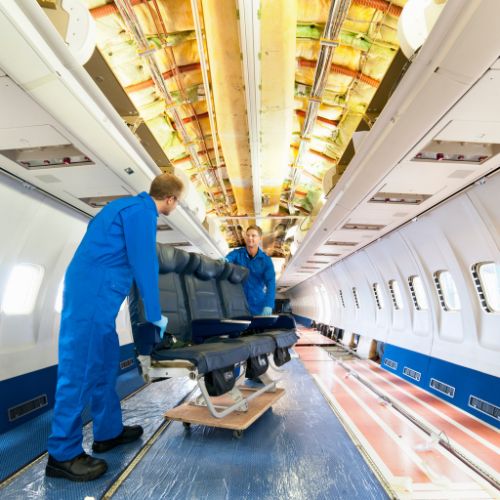
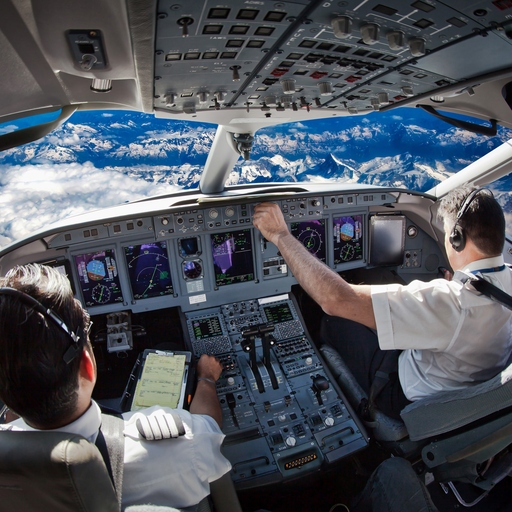
The Aircraft Maintenance Experience – Summer Workshop is designed to stimulate students’ interest in aviation engineering through structured, immersive, and hands‑on learning experiences, while developing foundational knowledge of aircraft maintenance. Through a blend of interactive workshops, introductory technical concepts, and authentic industry exposure, participants will gain an informed appreciation of the aircraft maintenance profession. The course also incorporates an introduction to aviation English, enabling learners to become familiar with commonly used terminology and basic documentation practices through the use of job cards and simple maintenance records. In addition, the workshop provides an overview of relevant education and career pathways, supporting students in making informed decisions regarding further studies and future opportunities in the aircraft maintenance sector.
Course Content:
- Fundamentals of Flights and Aircraft Types: Introduction to the theory of flight, the major differences between civil and military aircraft, and the identification of various Boeing and Airbus models
- Cockpit and Control Systems: Overview of the cockpit environment and the primary flight control surfaces (elevators and rudders) used to manoeuvre the aircraft
- Powerplants and Systems: Detailed look at the aircraft’s electrical systems, engines, and Auxiliary Power Units (APU), including their structure and function
- Instrumentation and Avionics: Exploration of flight gauages, engine parameters, and advanced navigation systems such as Autopilot, GPS, and ILS
- Operational Phases and Mechanics: Understanding the flight cycle from take-off to landing, alongside the mechanics of landing gear, brakes, and pressurisation systems
- Safety, Regulation, and Career Paths: Introduction to aviation authorities (ICAO and HKCAD), airworthiness standards, the role of maintenance engineers, and future career discussions
- Practical Experience: Includes a field trip to aircraft mock-up and a company visit to provide students with hands-on exposure to the aviation environment
DOWNLOAD PROGRAMME PAMPHLET
Intended Learning Outcomes:
- Explain the Theory of Flight: Articulate the basic concepts of how aeroplanes fly and identify the various differences between civil and military aircraft.
- Differentiate Aircraft Manufacturers: Contrast the specific design and structural variations between Airbus and Boeing aircraft.
- Identify Flight Control Surfaces: Recognize and describe the functions of primary flight control surfaces, including elevators, ailerons, rudders, and stabilizers, and secondary flight control surfaces including spoilers, flaps, and slats.
- Analyse Power & Systems: Understand the structure and function of aircraft electrical systems, engines, and Auxiliary Power Units (APU).
- Interpret Cockpit Instrumentation: Identify various gauges and indication parameters used for monitoring flight and engine status, alongside advanced systems like Autopilot, GPS and ILS.
- Summarise Operational Mechanics: Describe the mechanical processes involved in all phases of flight – take-off, cruise, descent, and landing – including the operation of landing gear, brakes, and pressurisation systems.
- Evaluate Safety & Regulations: Outline the roles of international and local aviation authorities (ICAO and HKCAD) and explain the requirements for maintaining aircraft airworthiness.
Remarks
- For enquiries or enrolment, please contact FTE@hkiaaacademy.com.
- A minimum of 15 participants is required for the course to be conducted
- Maximum capacity per session: 20 participants, on a first-come first served basis
- A light lunch will be provided each day
- Meeting Point: China Aircraft Services Limited – Main Gate
- Transportation: From Tung Chung Station Bus Terminus, take Citybus Route S52 to the Aircraft Maintenance