








Instructor Insights: A Captain’s Views on Modern Aviation Safety
AMASM Instructor Patrick Varin shares his thoughts on the evolving trends in aviation safety and how safety as a discipline is developing.
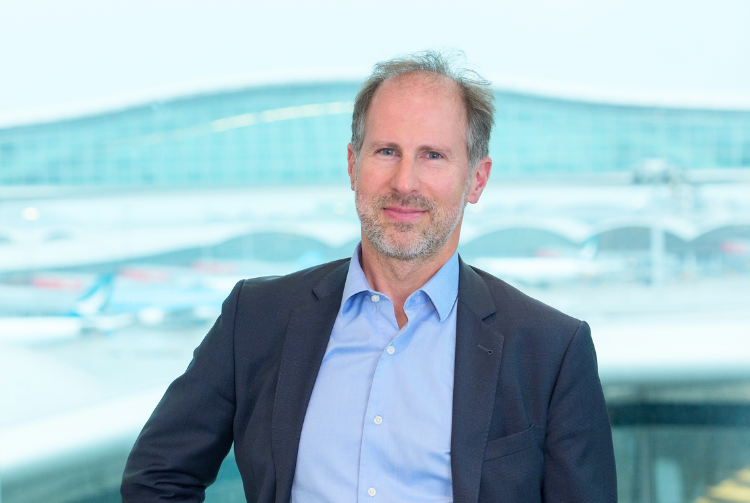
When contemplating aviation safety and leadership at Hong Kong International Aviation Academy (HKIAA), one of the first persons coming to mind is Captain Patrick Varin.
Shaped by countless hours in the cockpit and refined by decades of work in Safety Management and airline auditing, Captain Varin’s experience and perspectives are precisely what the students at HKIAA’s Advanced Master in Air Transport Management (AMATM) and the Advanced Master in Aviation Safety Management (AMASM) need.
Offered in partnership with Ecole Nationale de l’Aviation Civile (ENAC) at HKIAA, the AMATM has been running since 2017 while the AMASM was subsequently added to HKIAA's curriculum in 2025.
No plans for aviation (at first)
Growing up, Captain Varin did not have plans to pursue a career in aviation. In fact, he was passionate about cooking and thought he might become a chef. A pivotal flight from Paris to Martinique, arranged by his fighter pilot father, changed the trajectory of his life. During that long-haul flight spent in the jump seat, Captain Varin became fascinated with how a commercial flight was managed like a small business, a coordinated team effort with procedures to follow, risks to manage and safety to consider throughout every second of the flight.
Thus began his pursuit of becoming a pilot at ENAC. Over the course of 30 years, Captain Varin qualified to fly the Boeing 737-200, B737-500, Airbus A330, A340, A320 family and eventually, the B777.
Stepping beyond the cockpit
While many commercial pilots build fulfilling careers mostly on the flight deck, Captain Varin chose a broader path.
In the language of ICAO Annex 19, safety management rests on four pillars that are inter-connected reinforcing each other: policy, assurance, promotion and risk management. Captain Varin felt he had to step beyond the cockpit to fully embrace safety management and appreciate how the pillars link together, including how implementation differs across countries and operators.
When opportunity arose, he took on roles in safety management and airline auditing, becoming an auditor under the IATA Operational Safety Audit (IOSA) programme. The goal was not to become a “safety person” but a deliberate expansion of perspective: to understand safety as something designed, implemented, measured, and continuously improved across cultures, regulators, and operational realities.
Evolving trends in aviation safety
And the operational realities impacting aviation safety are many. There have been many recent trends and evolutions which operators need to pay close attention to. Captain Varin noted three significant trends which are daily concerns:
- Cybersecurity threats and regulation. Cyber risk is not just an IT concern but an operational safety issue. The subject is at the forefront of the European Union Aviation Safety Agency’s regulatory framework (Part-IS) safeguarding civil aviation from cyber threats.
- AI entering core safety processes. As AI becomes increasingly prevalent in safety management workflows such as documentation, report assessments and trend analyses, the need for governance, validation and human oversight is even more imminent.
- Conflict zone management. Operating in and around geopolitical conflict zones have amplified the complexities of piloting. The additional security countermeasures undertaken are making each flight a unique challenge for pilots.
Safety as a discipline
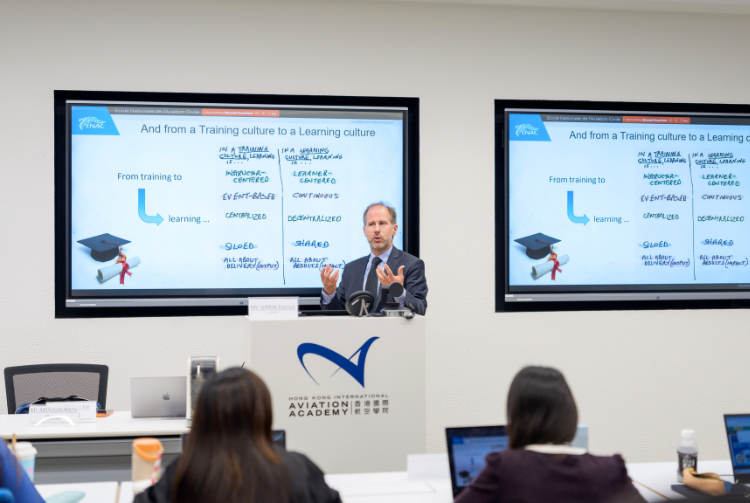
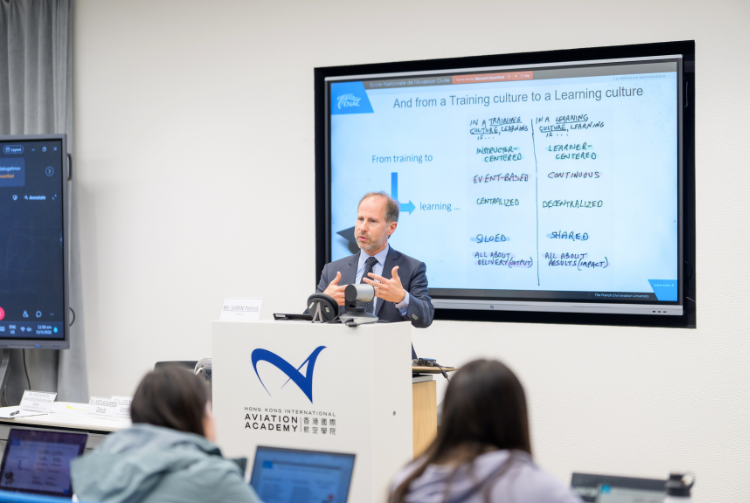
Captain Varin describes himself as “lucky and honoured” to have been given so much time by peers and mentors over the years of his career. Besides his twice a month long-haul flight duties on the Boeing 777, the twice-a-year IOSA audit responsibilities, and other work at the airline, teaching with ENAC and HKIAA is an opportunity for him to give back: transmitting experience to future generations so they can keep enhancing and promoting safety.
He views the classroom as a practical extension of the industry’s safety ecosystem, where safety is a discipline built on experience, continuous learning, and everyday choices that keep standards alive, especially when no one is watching.
Though he is an instructor of both advanced master programmes at HKIAA, Captain Varin acknowledges the AMASM delves deeper into emerging and cross-cutting safety management processes, including cybersecurity and the use of AI in aviation safety work. The AMASM cohort is often smaller, facilitating more time for high-quality discussions. The programme has also attracted more experienced aviation professionals already in senior roles and shaping decisions. The diversity of expertise changes the classroom dynamic: it becomes less about introducing concepts and more about stress-testing them against real operational constraints.
Hong Kong is a special classroom
Teaching in Hong Kong is particularly meaningful to Captain Varin because the city sits at the heart of international aviation. Between the AMASM and AMATM cohorts, his students span across authorities, airlines, airport operational staff, senior managers, and even professionals from other industries discovering aviation for the first time.
That mix creates a rare kind of learning environment: operational maturity meets new perspectives; different professional languages meet a shared aviation vocabulary. The result is discussions that enriches everyone in the room, including the instructor.